Lighting Guides
How to Choose an LED Glass Lens for High Bay Lighting
High bay lenses decide how evenly light covers a hall floor and how much glare workers see. This guide explains beam angle, mounting height and uniformity, so you can match a ZG57 lens to your space.
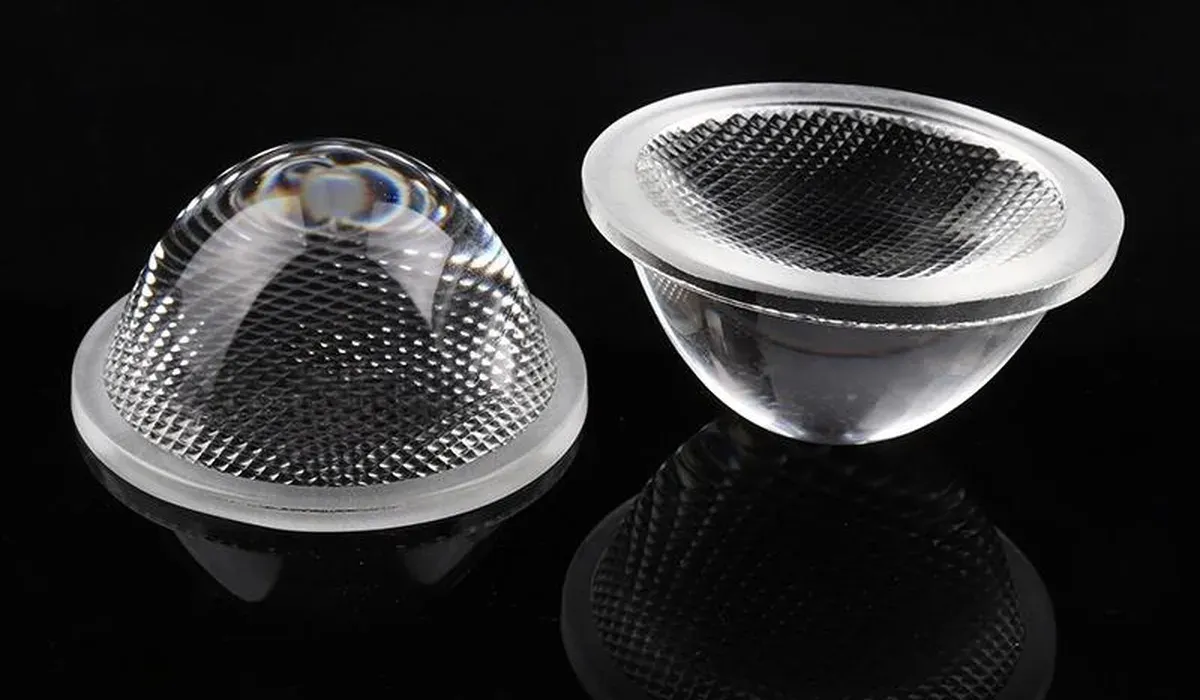
High bay lighting has to cover a large floor area from a high ceiling, evenly and without glare. The lens decides how wide the light spreads and how uniform the floor looks. This guide explains beam angle, mounting height and uniformity, so you can match a ZG57 lens to your hall.
What a high bay lens does
A high bay lens sits over the LED or COB source and shapes its light into a controlled beam. Without a lens the light spreads in every direction and much of it is wasted. With the right lens, the light lands where it is needed — on the floor and work surfaces below — and the space looks evenly lit.
Round symmetric distribution
ZG57 high bay lenses have a round symmetric distribution, which means the beam is the same in every direction around the luminaire. That suits open halls and workshops where the light must spread evenly outwards from each fitting, rather than being pushed to one side as on a road.
Beam angle: 45° or 60°
ZG57 high bay lenses come in two beam angles: 45° and 60°. The 45° variant gives a tighter, deeper beam for higher mounting, and the 60° variant gives wider coverage for lower mounting. Both share the same 100–300 W LED range, so the choice is about beam angle and size, not power.
Mounting height and floor coverage
Mounting height and beam angle together decide how large a circle of light each luminaire covers on the floor. A higher mounting needs a narrower beam to keep the light bright on the floor, while a lower mounting can use a wider beam. Measure the mounting height and the floor area each luminaire must cover before choosing between 45° and 60°.
LED power and luminous surface: 100–300 W
Both ZG57 high bay variants are made for 100–300 W LED or COB sources with a luminous surface of Φ6–20 mm. Check that your source matches the power range and the luminous surface size, because the lens is designed around that source.
Uniformity and glare
Uniformity is how evenly the light covers the floor — ZG57 lenses are rated for excellent uniformity. Glare is how much the bright source bothers workers looking up — the micro-structures on the lens surface keep glare extremely low. The catalogue gives no U0, UI or TI results for high bay models, so do not expect those numbers; judge the lens on beam angle, uniformity and the space it will light.
Where ZG57 high bay lenses are used
ZG57 high bay lenses are used for high bay lighting, projector lighting, indoor architectural lighting and general lighting, including industrial halls and horticultural lighting. The borosilicate glass works from −50 to 450 °C, and the lens size is compact — 57 x 28.3 mm for the 45° variant and 57 x 21.3 mm for the 60° variant.
Checklist: matching a ZG57 lens to your hall
Work through the checklist below before you order. If any answer is unclear, confirm the exact variant with Glasvio first — the catalogue lists two ZG57 high bay variants, 45° and 60°.
- Measure the mounting height and the floor area each luminaire must cover.
- Pick the beam angle for that height: 45° for a tighter, deeper beam, 60° for wider coverage.
- Check the LED power and luminous surface: 100–300 W, Φ6–20 mm.
- Check uniformity and glare for the space — workshops, halls and horticultural lighting all differ.
- Confirm the exact variant with Glasvio before ordering — the catalogue lists two ZG57 high bay variants, 45° and 60°.
Learn more: