Lighting Guides
How to Choose an LED Glass Lens for Street Lighting
Street light lenses decide where the light goes and how much glare drivers see. This guide explains Type II distribution, beam angle, uniformity and glare, so you can match a ZG95 lens to your road.
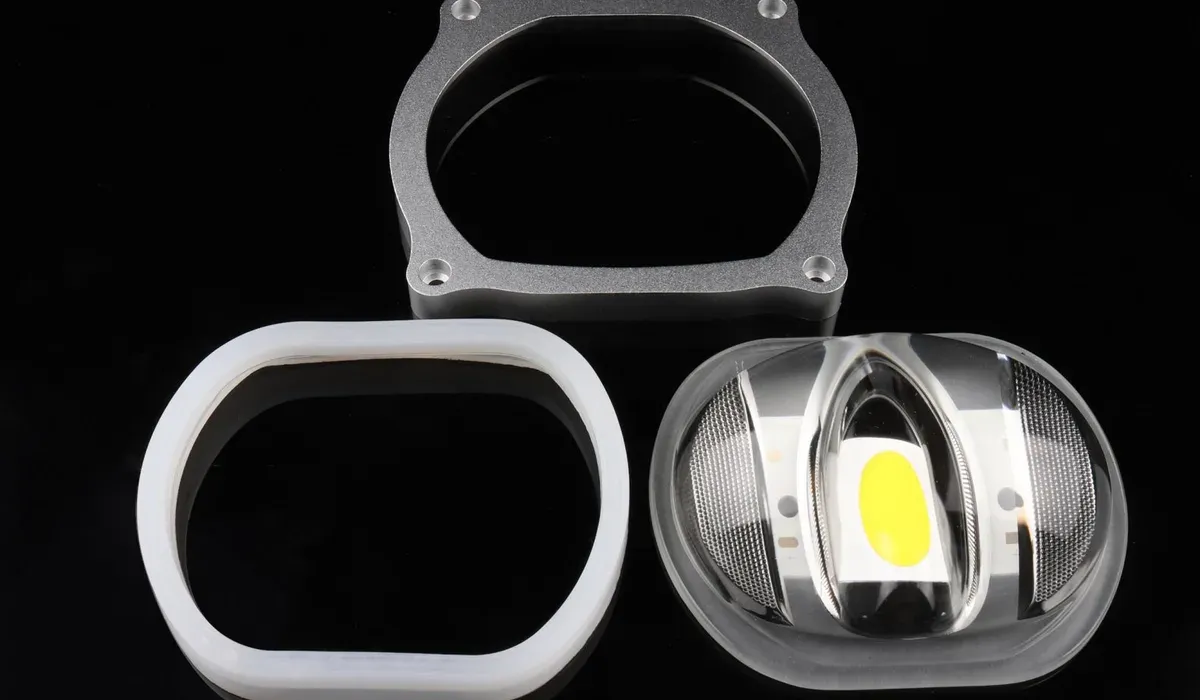
A street light lens decides where the light goes — and how much glare drivers see. This guide explains Type II distribution, beam angle, uniformity and glare, using the ZG95 Series Street Light Glass Lens as the example, so you can match a lens to your road.
What a street light lens actually does
A street light lens is the glass optic in front of the LED. It takes the light from the LED or COB source and shapes it into the beam the road needs, instead of letting it spill in every direction. The ZG95 Series is an oval glass lens for street and road lighting, made of borosilicate glass and sized 95 x 63.9 x 28 mm, for 30–200 W LED / COB sources with a luminous surface of Φ22–30 mm or 24 x 24 mm.
Type II Medium: the distribution made for roads
Roads are long and narrow, so a street light lens must throw light along the road, not across it. Type II Medium is the distribution made for roads: it spreads light in a wide, even pattern along the road while keeping the beam controlled across it. In the ZG95 Series, all four variants use this same Type II Medium distribution.
Beam angle: 145° or 150° — what changes on the road
The ZG95 Series comes in two beam angles. The FWHM is 60° in one direction and 145° or 150° in the other: the 145° versions are the ZG95-4A and ZG95-4B, and the 150° versions are the ZG95-5A and ZG95-5B. The wider 150° beam spreads light further along the road, and its catalogue results are slightly different — UI 0.92 and TI 14, against UI 0.94 and TI 11 for the 145° versions. Efficiency also differs by variant: 95% for the ZG95-4A, 94% for the ZG95-4B, 93% for the ZG95-5A and 94% for the ZG95-5B.
Asymmetric angle and pole overhang
All four ZG95 variants have a 10° asymmetric angle. That asymmetry matches how a street light sits on a pole: the lens is made for one-side roads and two-side roads, and for poles with a 1 to 2.5 m overhang. Check the overhang and the road layout first — they decide which side of the road the light must reach.
Uniformity: what U0 and UI tell you
Uniformity is how evenly the road is lit. In the catalogue, U0 is 0.66 for all four ZG95 variants. UI is 0.94 for the 145° versions and 0.92 for the 150° versions. Compare these values for the variant you are considering — a higher UI means the light is more even along the road.
Glare: TI, the 80° cut-off, and micro-structures
Glare is what a driver sees when light shines straight into the eyes. The ZG95 Series has no luminous intensity above 80°, and its arrangement complies with the luminous intensity and glare index class. Micro-structures on the lens surface give extremely low glare. TI, the threshold increment, is 11 for the 145° versions and 14 for the 150° versions — lower is better for the driver.
Matching the lens to your LED: power and luminous surface
The ZG95 Series is made for 30–200 W LED or COB sources. The luminous surface must be Φ22–30 mm or 24 x 24 mm. The lens is 95 x 63.9 x 28 mm, with a tolerance of ±0.25 mm, made of borosilicate glass with a working temperature of -50 to 450 °C. Check your LED power and luminous surface against these numbers before you order.
A 5-item checklist before you order
- Confirm the road type — one-side or two-side. 2. Confirm the beam — 145° or 150°. 3. Confirm the LED power, 30–200 W, and the luminous surface, Φ22–30 mm or 24 x 24 mm. 4. Check the uniformity and glare results (U0, UI, TI) for the variant. 5. Confirm the exact A or B variant with Glasvio before ordering — the catalogue does not explain the A or B difference.
Learn more: